
I keep hearing the same things in Belmont.
Our taxes are too high.
It’s the schools.
We don’t have enough businesses.
Nobody wants to spend money here.
People are going to lose their homes.
And honestly? I think there is a bigger question we aren’t asking often enough:
What if we keep blaming the symptoms without examining the systems producing them?
I recently attended a Belmont Selectmen meeting and learned that the town has been offering 50% property-tax abatements for five years to some businesses willing to locate here. I was also reminded of capital projects the town has funded, sometimes with federal grants.
So let’s retire the idea that Belmont simply “doesn’t spend money.”
We do.
Sometimes the money comes directly from our property taxes. Sometimes it comes through state or federal programs funded by taxes we already pay. Either way, there is a taxpayer sitting somewhere behind the check.
And then there’s the property the town purchased more than 20 years ago that we’re still debating what to do with.
If we’ve spent two decades trying to decide what to do with a property because we supposedly “never want to spend money,” while simultaneously saying we want more green space, more economic activity, a charming village center, and lower taxes, perhaps the problem isn’t simply that Belmont spends too much.
Maybe we have a planning problem.
Maybe we have an economic-development problem.
Maybe we have a state-policy problem.
Maybe we have a representation problem.
And perhaps it’s all of those things at once.
Follow the problem upstream.
This is where I think our conversations about government—and especially our conversations about our state legislators—need to become more sophisticated.
Belmont isn’t unique. Small New Hampshire communities are dealing with pressures involving property taxes, school funding, infrastructure, limited commercial tax bases, housing affordability, and an aging population.
Yet when we talk about why things are difficult here, the legislature often seems to disappear from the conversation.
That’s fascinating to me.
Because the state legislature makes decisions that affect the framework within which our towns operate.
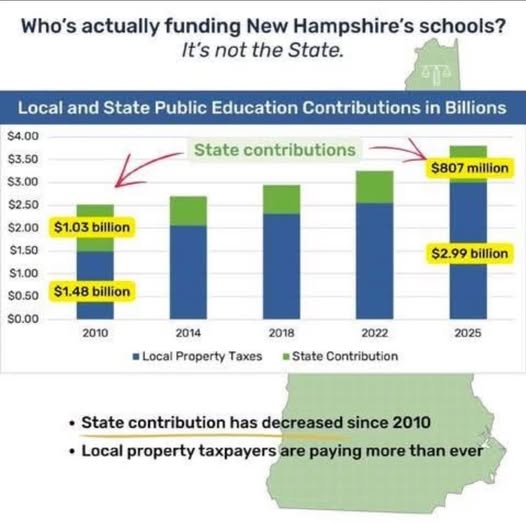
Education funding is one obvious example. The recent legislative record around HB 1815 and HB 1300 provides an interesting case study—not because public-comment numbers are a perfect measurement of constituent opinion, but because they allow us to ask how legislators respond when substantial public opposition is recorded.
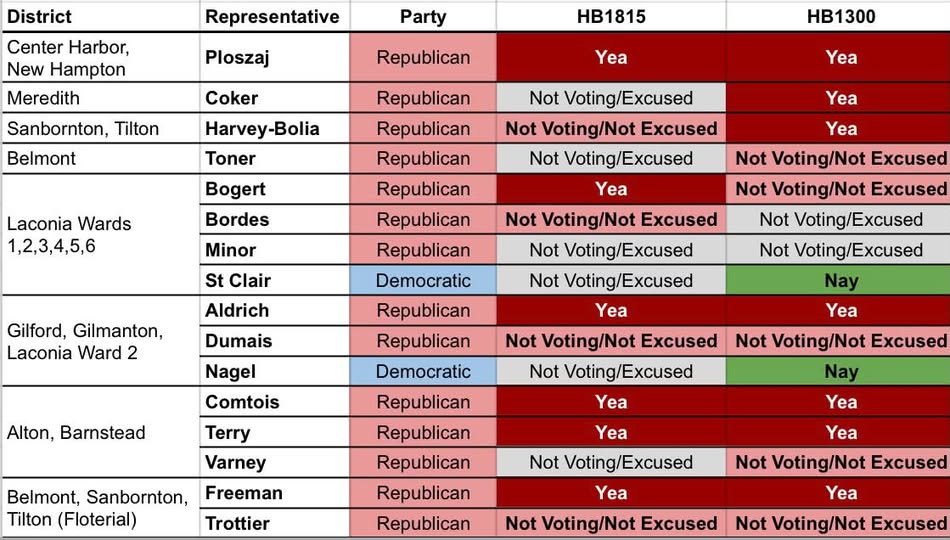
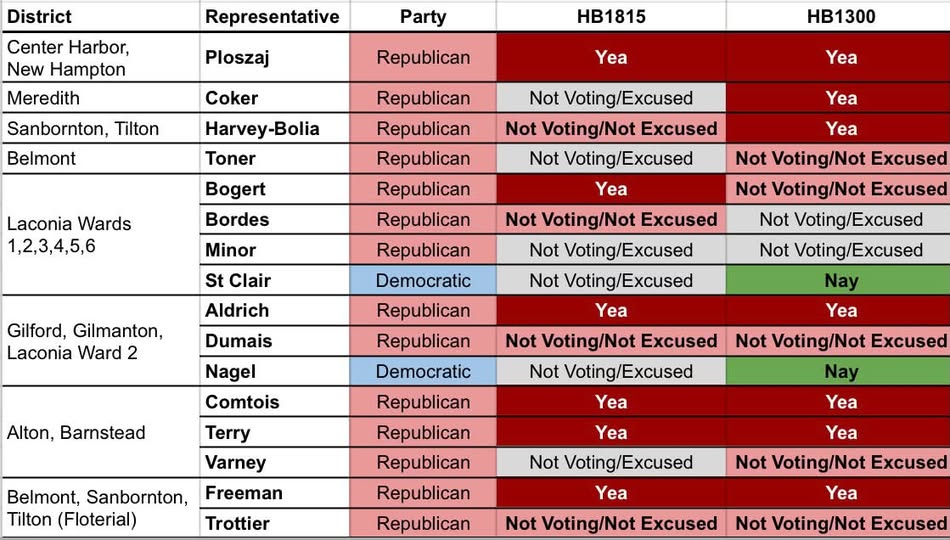
For HB 1815, 1,033 people submitted opposition testimony compared with 8 in support—approximately 99.2% opposed among those recorded submissions. The House ultimately passed the bill 188–162. Among Belknap County’s 16 House representatives, 6 voted yes, 0 voted no, 5 did not vote, and 5 were excused. That means every Belknap representative who cast a substantive yes/no vote voted in favor. (New Hampshire General Court, 2026a; League of Women Voters of New Hampshire, 2026)
HB 1300 tells a similar—but not identical—story. At the Senate hearing, 619 people signed in opposition and 35 in support, approximately 94.6% opposed among those recorded sign-ins. The final House conference vote was 183–170. Of Belknap’s 16 representatives, 7 voted yes, 2 voted no, 4 did not vote, and 3 were excused. (New Hampshire General Court, 2026b)
Now, before anyone jumps down my throat:
No, this does NOT mean 99% of Belknap County opposed HB 1815.
The testimony numbers aren’t a scientific poll. They’re statewide participation numbers, and people who submit testimony are a self-selected group.
But that doesn’t make the numbers meaningless.
It gives us a reason to ask:
What did our representatives hear from their constituents?
What evidence did they consider?
What did they believe outweighed the concerns being presented?
And perhaps most importantly:
How do we know?
Turnout isn’t the whole story.
This is where I think we can accidentally create another problem by blaming voters.
“People should have voted.”
Sure.
Voting matters.
But who has the time, transportation, accessibility, childcare, internet access, knowledge, confidence, physical ability, or emotional bandwidth to participate?
Intersectionality reminds us that people’s ability to participate isn’t distributed equally across society (Crenshaw, 1989).
A disabled resident may encounter barriers a nondisabled resident doesn’t.
A working parent may have different constraints than a retiree.
A low-income household may experience a property-tax increase differently from a household with substantial disposable income.
A rural resident without reliable transportation may have a completely different relationship with government access than someone living near the center of town.
So when someone says:
“Well, if people cared, they would have shown up.”
I’m not convinced that’s an ethically sufficient answer.
Absence from a meeting isn’t consent.
Silence isn’t agreement.
And failing to participate in one particular political mechanism doesn’t tell us what someone actually believes.
Procedural justice asks whether people have meaningful opportunities to participate and whether their voices are treated fairly. An intersectional approach pushes us one step further:
Who isn’t in the room—and why?
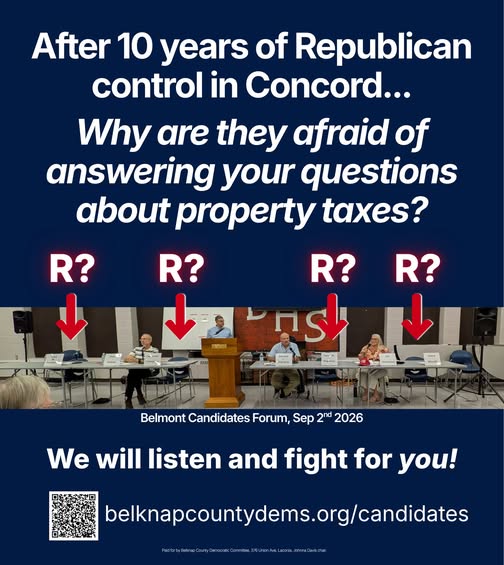
But representatives aren’t robots, either.
There’s another side to this.
Being an elected representative doesn’t mean simply counting constituent emails and voting whichever way has the largest number.
Representatives have their own responsibilities. They evaluate evidence, legislation, constitutional questions, fiscal consequences, and competing constituent interests.
So I don’t think the ethical question is:
“Did you vote exactly the way I wanted?”
It’s:
“Can you explain how you arrived at your decision—and demonstrate that you took the people you represent seriously?”
That’s a very different standard.
It moves us away from partisan tribalism and toward democratic accountability.
And this brings me back to Belmont.
If residents have been complaining about property taxes for decades…
If we’ve been talking about the schools for decades…
If we’ve struggled with limited commercial development for decades…
If we’ve been discussing the village center for decades…
If we’ve owned a property for more than 20 years without reaching a satisfying consensus about its future…
Maybe the question isn’t simply:
“Why haven’t voters fixed this?”
Maybe we should ask:
“What have we been voting for?”
Not as an accusation.
As an investigation.
Because if a community has experienced the same problems for 20, 30, 40, or 50 years, it seems reasonable to examine the policies and political choices that have accompanied those decades.
That doesn’t mean Republicans are inherently bad.
It doesn’t mean Democrats automatically have the answers.
And it certainly doesn’t mean every Republican voter agrees with every Republican policy.
People are more complicated than party labels.
But if one political coalition has dominated a community or state government for a long period of time, it is entirely legitimate for voters to examine that governing record and ask whether the policies being pursued are producing the outcomes they actually want.
That’s not partisan.
That’s accountability.
Maybe the answer is to elect different people.
Maybe it’s to elect Republicans who approach these issues differently.
Maybe it’s to elect Democrats.
Maybe it’s some combination.
But shouldn’t we at least be willing to look at the evidence before assuming the next election should simply reproduce the last one?
Because doing the same thing for decades while expecting dramatically different results is not really a political philosophy.
It’s a hypothesis.
And hypotheses are supposed to be tested.
🥊 Maybe it’s time to stop asking only, “Who didn’t vote?”
Maybe we should start asking:
Who did we elect?
What did they do?
What did they hear?
What did they prioritize?
And are those choices actually producing the Belmont we keep saying we want?
That’s a much more interesting conversation.
And, frankly, one I think we’re overdue for.
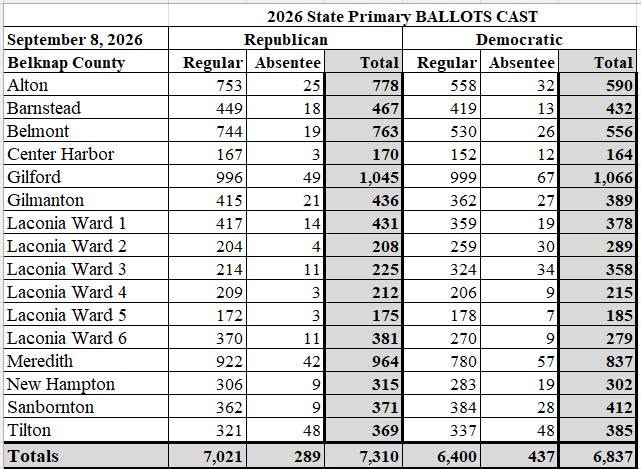
Who Represents Belmont? Voices and Votes Matter
Recent discussions about Belmont’s property taxes, economic development, schools, and long-standing challenges have made me think about representation differently. It is easy to attribute local problems to voter turnout or to say that residents simply need to “vote differently.” However, an inclusive and intersectional framework asks a more complicated question: Who has the opportunity to participate, whose voices are heard, and how are elected officials accountable for the decisions they make? Intersectionality reminds us that political participation is shaped by overlapping factors such as disability, income, transportation, employment, care giving responsibilities, geography, and access to information (Crenshaw, 1989). Therefore, low participation should not automatically be interpreted as agreement, apathy, or consent.
The recent legislative record concerning education and taxation illustrates why this distinction matters. For HB 1815, which became law as Chapter 19 and concerns education financing, the New Hampshire House passed the bill 188–162; among the 16 Belknap County representatives, 6 voted yes, 0 voted no, 5 did not vote, and 5 were excused. Thus, 100% of Belknap representatives who cast a substantive yes/no vote voted in favor (New Hampshire General Court, 2026a). The public-input record was substantially different: 1,033 people submitted online opposition compared with 8 in support, although these submissions were statewide and self-selected rather than a scientific survey of Belknap County (League of Women Voters of New Hampshire, 2026). HB 1300 presents a similar representation question. The Senate hearing recorded 619 people opposed and 35 in support, while the final House conference vote was 183–170. Among Belknap representatives, 7 voted yes, 2 voted no, 4 did not vote, and 3 were excused (New Hampshire General Court, 2026b). Again, the public-comment record cannot tell us what every Belmont or Belknap resident believed, but it does provide evidence that substantial numbers of residents were attempting to communicate their concerns to legislators.
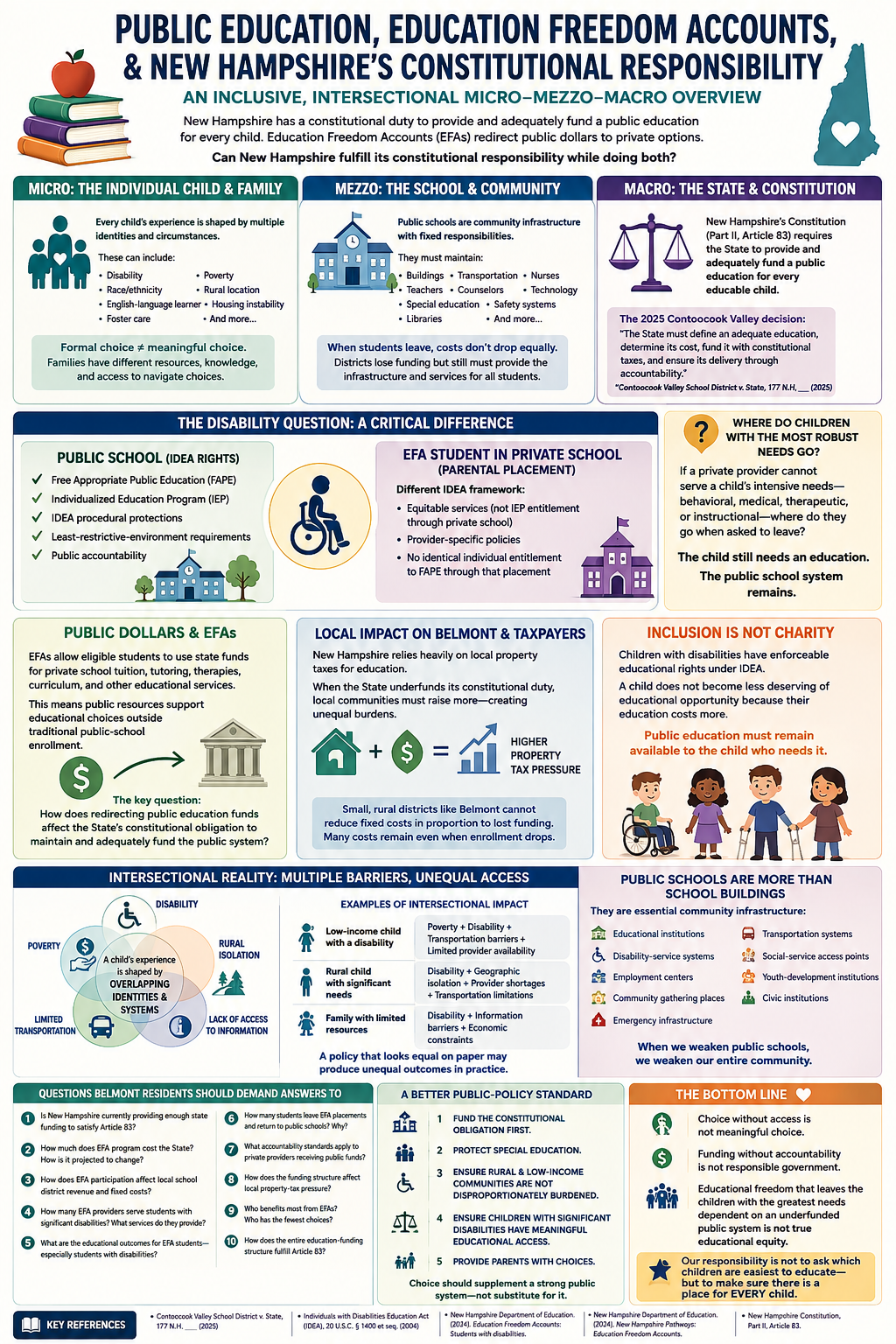
This raises an ethical issue beyond simply asking whether people voted. Representation requires more than counting who showed up at the ballot box; it also requires meaningful opportunities for constituents to communicate and a transparent explanation of how that information was weighed. Procedural justice emphasizes fair participation and voice, while an ethics-of-care framework emphasizes relationships and responsibilities between decision-makers and affected communities. From a micro/mezzo/macro perspective, individual residents may face barriers to participation; community institutions shape opportunities for engagement; and state-level policies ultimately affect local taxes, schools, housing, disability services, and economic stability. New Hampshire’s EFA statute itself recognizes that state education policy can affect local school funding: RSA 194-F directs EFA transfers through the Education Trust Fund and requires legislative oversight of the program’s impact on local district schools (N.H. Rev. Stat. § 194-F:2, 11–12, 2026).
For me, the most productive question is therefore not simply whether Belmont residents have “voted correctly.” It is whether decades of persistent local concerns should prompt us to examine the policies, institutions, and elected decisions that have produced those conditions. If residents repeatedly identify property taxes, economic development, school funding, and affordability as concerns, dismissing them as merely a failure of turnout places the burden primarily on individuals rather than examining the larger system. At the same time, ethical analysis requires avoiding the opposite assumption that every resident shares the same political preference. The evidence supports asking representatives to explain how they weighed constituent concerns, legislative evidence, party positions, and their own policy judgments—not assuming their motives.
Ultimately, democratic accountability should not be reduced to “Did enough people vote?” A more inclusive question is: Who was able to participate, whose experiences were represented, what evidence did elected officials consider, and how can constituents evaluate whether their representatives responded to the problems they were elected to address? That approach allows Belmont residents to reconsider voting patterns without turning political disagreement into partisan blame. It also recognizes that meaningful democratic participation is an ongoing relationship between constituents and representatives, not something that occurs only on Election Day.
References
Crenshaw, K. (1989). Demarginalizing the intersection of race and sex: A Black feminist critique of antidiscrimination doctrine, feminist theory and antiracist politics. University of Chicago Legal Forum, 1989(1), 139–167.
League of Women Voters of New Hampshire. (2026). Issues and actions. League of Women Voters of New Hampshire
New Hampshire General Court. (2026a). HB 1815: Relative to education financing—House roll call 107. HB 1815 legislative record
New Hampshire General Court. (2026b). HB 1300: Establishing a school district local tax cap question for the state general elections of 2026 and 2028. HB 1300 legislative record