
The progression of State v. Tania S. Byington in Cibola County illustrates how criminal a case develop in stages, often changing as evidence is reviewed and legal standards are applied. What may appear as “inconsistency” in early public records is usually the normal result of how the criminal justice system narrows allegations over time, from initial arrest, to formal charging, to district court proceedings.
This analysis is based on court records from:
- State v. Tania S. Byington, M-61-FR-202600067 (Cibola County Magistrate Court, 2026)
- State v. Tania S. Byington, D-1333-CR-202600057 (Cibola County District Court, 2026)
1. Magistrate Court Stage: Initial Charging and Why It a Is Broad Case
Tania Byington’s case began on April 20, 2026, in magistrate court, under Case No. M-61-FR-202600067, before Magistrate Judge Tony L. Mace (Cibola County Magistrate Court, 2026a).
At this early stage, she was charged with:
- Second Degree Murder (F2)
- Tampering with Evidence (F4)
What “magistrate court” means (in simple terms)
A magistrate court is the first level where a criminal case enters the system. Think of it as an initial screening stage, not a trial.
At this point:
- The court is not deciding guilt or innocence
- The prosecutor is presenting early allegations, not final conclusions
- The legal standard is probable cause, meaning “there is enough reason to believe a crime may have occurred”
Why early charges are often broad
Early charging decisions are typically based on incomplete information, such as:
- preliminary witness statements (first accounts from people involved or nearby)
- initial police investigative reports (early summaries of evidence collection)
- early forensic impressions (basic interpretation of physical evidence before full analysis)
These filings are not final determinations—they are starting points that allow the case to proceed into formal review (Cibola County Magistrate Court, 2026a).
2. First Major Change in the Case: Dismissal of the Murder Charge
On April 21, 2026, the Second Degree Murder charge was dismissed using a legal procedure called nolle prosequi (Cibola County Magistrate Court, 2026b).
What “nolle prosequi” means (plain language)
Nolle prosequi is a Latin legal term meaning:
“the prosecutor is choosing not to continue pursuing this specific charge right now.”
It is important to understand what it is—and what it is not.
It does NOT mean:
- the person was found not guilty
- the person was cleared or exonerated
- the case is over
It DOES mean:
- the prosecution stopped pursuing that specific charge at that stage of the case
Why this happens
Prosecutors may dismiss a charge for several reasons, including:
- evidence of intent (whether someone meant to cause harm) is not yet strong enough
- investigators are refining their theory of what happened
- the focus shifts to another person as the primary actor
- witness statements are clarified or change during early investigation
Importantly, this is not a final judgment—it is a strategic adjustment based on evolving information, not a declaration of innocence (Cibola County Magistrate Court, 2026b).
3. Why the Case Continued After the Murder Charge Was Removed
Even after the murder charge was dismissed, the case continued under:
- Tampering with Evidence (initially F4, later elevated in district court)
What “tampering with evidence” means (plain language)
This charge refers to actions where a person is accused of:
interfering with evidence connected to a criminal investigation.
This can include:
- hiding evidence
- destroying evidence
- moving evidence to prevent discovery
- altering evidence to mislead investigators
Why it can stand alone
This charge is legally separate from homicide because:
- Murder focuses on causing a death
- Tampering focuses on what someone allegedly did with evidence afterward
This means a person can be charged with tampering even if:
- they are not accused of causing the death
- they are only accused of actions after the alleged event (Cibola County District Court, 2026a)
4. Release on Personal Recognizance (PR): What It Means and Why It Was Granted
On April 20, 2026, Tania Byington was released on personal recognizance (PR) (Cibola County Magistrate Court, 2026a).
What “personal recognizance” means (plain language)
A personal recognizance release means:
the person is released from custody based on their written promise to return to court.
No bail money is required.
Instead, the defendant agrees:
- to attend all court hearings
- to follow court rules while the case is pending
What the court must consider before deciding detention vs. release
Under the New Mexico Constitution (Article II, Section 13), a person can only be held in jail before trial if the state proves:
- they are likely to flee (flight risk), OR
- they pose a danger to the public
“Clear and convincing evidence” means the prosecution must show strong, reliable proof—not just suspicion.
If that standard is not met, the court must choose the least restrictive option, which may include PR release.
Why PR is more common in tampering-related charges
Compared to homicide allegations, courts may consider:
- no direct accusation of causing physical harm
- lower potential sentencing range than murder charges
- reduced classification of independent dangerousness
- allegations focused on post-incident conduct rather than violence
Important clarification
PR release does NOT mean:
- the case is weak
- the evidence is insufficient
- the charges are minor or unimportant
It only means:
the court did not find legal justification to keep the person in jail before trial under constitutional standards (N.M. Const. art. II, §13; Cibola County Magistrate Court, 2026a).
5. Why Tania and David Byington Case’s Are Treated Differently in Charging Theory
Court records show a separation in how each defendant is legally described.
David Byington (as reflected in filings)
- identified as the alleged primary actor
- associated with the act causing death
- tied to direct causation evidence (what allegedly caused the fatal outcome)
Tania Byington
- associated with alleged actions after the incident
- focused on handling or interference with evidence
- treated under a different legal category (tampering rather than direct violence)
What this means in plain language
The prosecution is separating two questions:
- Who is alleged to have caused the death?
- Who is alleged to have done something after the fact involving evidence?
These are legally different roles requiring different types of proof (Cibola County District Court, 2026a).
6. Why Dropping the Murder Charge Did Not End the Case
The case continued because:
- tampering charges can exist independently of homicide charges
- prosecutors are allowed to adjust charges as evidence develops
- early charges can be refined as investigations become more detailed
In other words:
removing one charge does not erase the entire case, it often narrows it (Cibola County District Court, 2026a).
7. Current Status in District Court Case
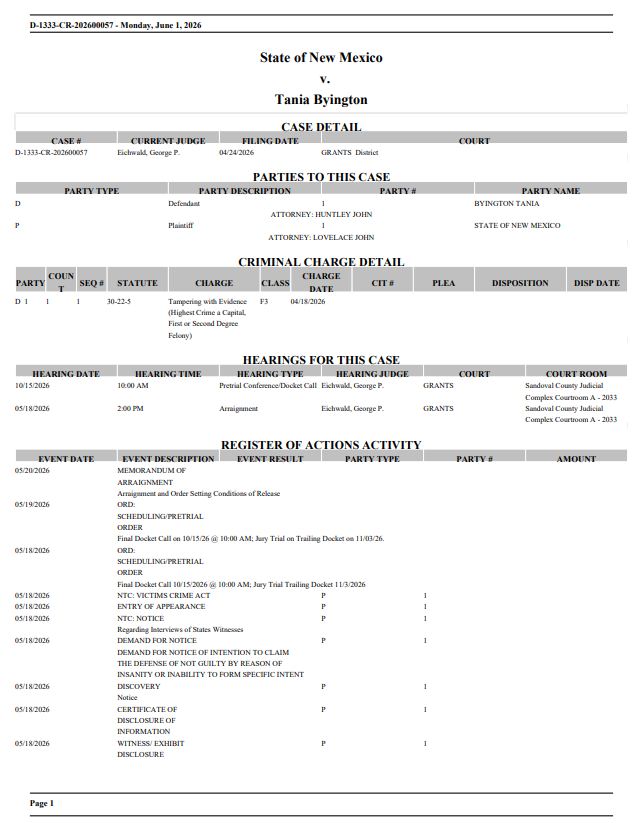
The case was transferred to district court under:
- Case No. D-1333-CR-202600057
At this stage, the case is in the pretrial phase, meaning:
- no trial has occurred yet
- both sides are exchanging evidence (called discovery)
- hearings and legal motions are being prepared
- trial scheduling is set for late 2026
What “pretrial phase” means (plain language)
This is the investigative courtroom phase before a jury ever hears the case. It focuses on:
- evidence review
- legal arguments about what can be used at trial
- procedural preparation
It is not a determination of guilt or innocence (Cibola County District Court, 2026a).
8. Why the Public Often Misunderstands These Changes
Cases like this can appear confusing because:
- early charges often reflect maximum possible allegations
- later filings narrow or refine those allegations
- legal roles of co-defendants are separated even when factually connected
- media summaries often compress complex legal steps
As a result:
what looks like inconsistency is usually standard legal progression as evidence is tested and refined.
9. Key Clarification: PR Release Does Not Indicate Case Strength
One of the most common misunderstandings is assuming that release conditions reflect how “strong” or “weak” a case is.
However:
PR release only means:
the court did not find legal justification to detain the person before trial.
It does NOT mean:
- the allegations are false
- the evidence is weak
- the charges are unlikely to proceed
Under New Mexico law, liberty before trial is the default unless the state meets a high evidentiary burden (N.M. Const. art. II, §13).
10. Grand Jury Indictment: Why the Case Moved Into Formal Felony Court
After the early magistrate court stage, Tania Byington’s case was later transferred into district court under:
- State v. Tania S. Byington, D-1333-CR-202600057
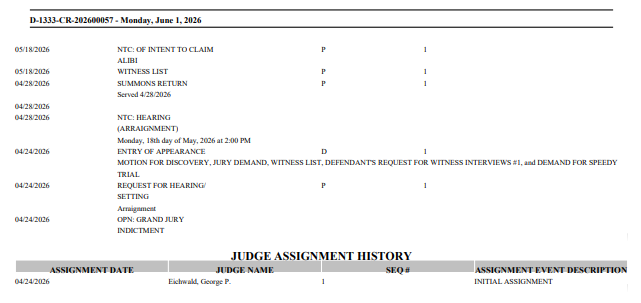
A key procedural development in this stage is the entry of a grand jury indictment on the tampering-related charge.
What a “grand jury indictment” means (plain language)
A grand jury is a group of citizens (not a trial jury) who are asked to review evidence presented by the prosecution.
Their job is not to decide guilt or innocence.
Instead, they answer one question:
“Is there enough evidence to formally charge someone with a felony and send the case to district court for trial?”
If they agree there is enough evidence, they issue something called an:
Indictment
This is a formal written accusation that:
- replaces or supersedes earlier charging documents
- moves the case into full felony trial court jurisdiction
- confirms the case will proceed beyond preliminary review
Important distinction: indictment is NOT a conviction
A grand jury indictment does NOT mean:
- the defendant is guilty
- the evidence has been proven in court
- a judge has evaluated all facts
It only means:
a group of citizens found “probable cause” to formally charge the case as a felony in district court.
Why prosecutors use a grand jury
Grand juries are often used in serious felony cases because they allow prosecutors to:
- present evidence confidentially (no defense present during this stage)
- consolidate witness testimony and investigative findings
- formalize charges after early magistrate-stage adjustments
- strengthen the case structure before trial preparation
How this fits into Tania Byington’s case
In this case progression, the indictment reflects a shift from:
Early stage (Magistrate Court)
- initial arrest charges
- broad allegations based on early investigative information
Later stage (Grand Jury → District Court)
- refined charge focused on tampering with evidence
- formal felony-level prosecution structure
- preparation for full pretrial litigation and possible jury trial
This means the system has moved from:
“Should this case be investigated further?”
to:
“This case will proceed to formal trial court review.”
Key legal effect of indictment in this case
Once indicted:
- the case is permanently placed in district court jurisdiction
- prosecution proceeds under formal felony rules
- defense gains full discovery rights (access to evidence)
- pretrial motions and hearings begin shaping what a jury may eventually see
Bottom line (plain language summary)
A grand jury indictment is not a finding of guilt.
It is:
the legal system’s way of saying there is enough evidence for the case to proceed into full felony trial court.
In Tania Byington’s case, the indictment marks the transition from early investigative charging decisions into formal district court prosecution focused on tampering allegations.
Conclusion: Legal Process vs. Public Interpretation
The Byington case demonstrates how criminal proceedings evolve through structured legal stages rather than fixed narratives.
Tania Byington’s progression, from initial homicide allegation, to dismissal of that charge, to continued prosecution for tampering, reflects:
- evidence refinement
- prosecutorial reassessment
- constitutional limits on detention
- separation of legal roles between co-defendants
As the case moves forward into discovery and pretrial litigation, the final legal outcome will depend on:
- what evidence is ultimately admissible
- how witnesses and forensic findings align
- how the prosecution structures its case at trial