
Introduction
As a Belmont, New Hampshire homeowner, constituent, and community member, I believe we need to have a much more honest conversation about what is happening to public education in our state. I believe parents deserve meaningful choices for their children. I also believe that public education is a public responsibility, and that responsibility becomes even more important when we consider children with disabilities, children living in poverty, English-language learners, rural families, and other students whose educational needs may not be equally accommodated by every educational provider.
For me, this is not simply a debate about whether someone supports or opposes “school choice.” It is a question of constitutional responsibility, fiscal accountability, educational equity, disability rights, and the sustainability of the public institutions that New Hampshire requires to educate every child.
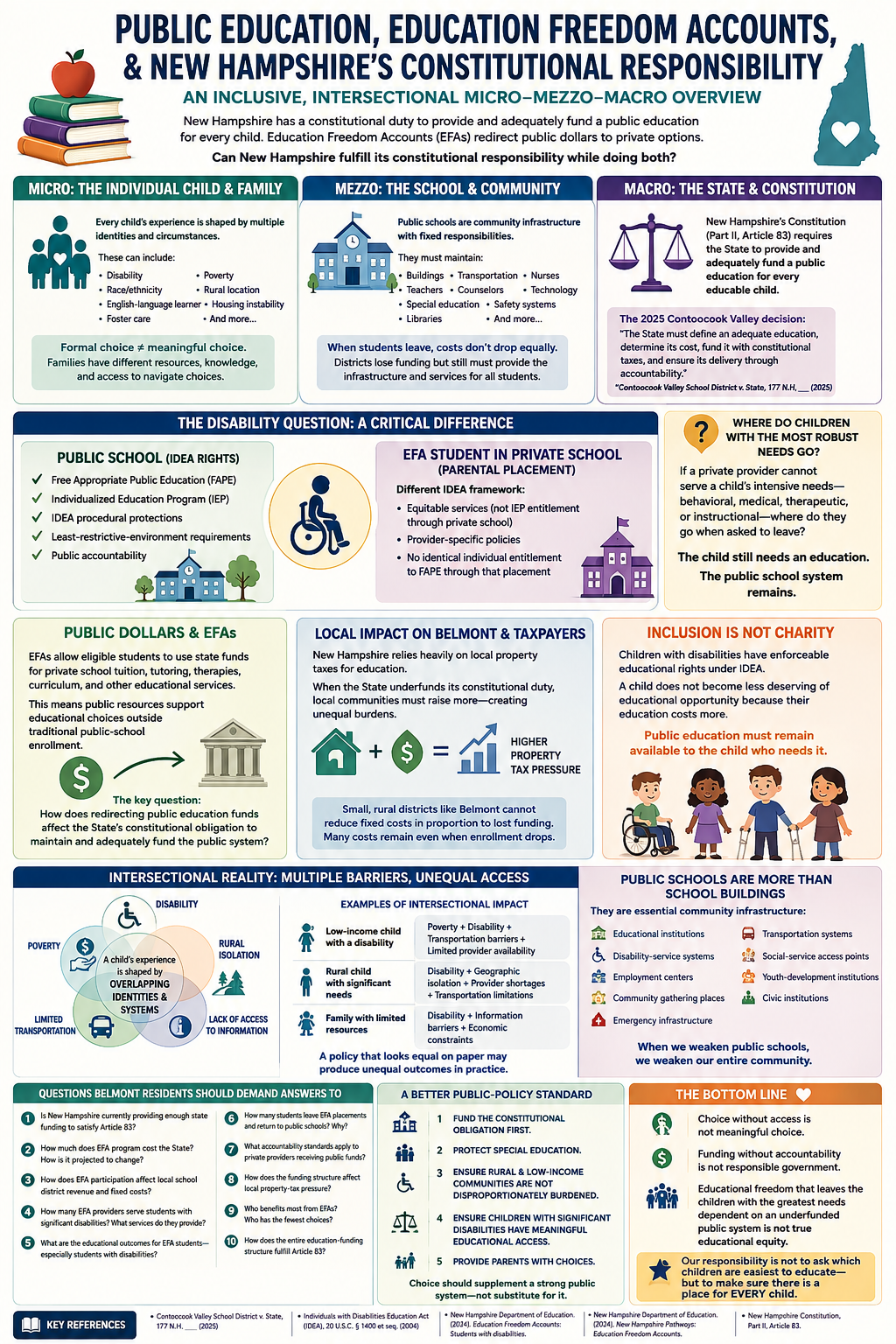
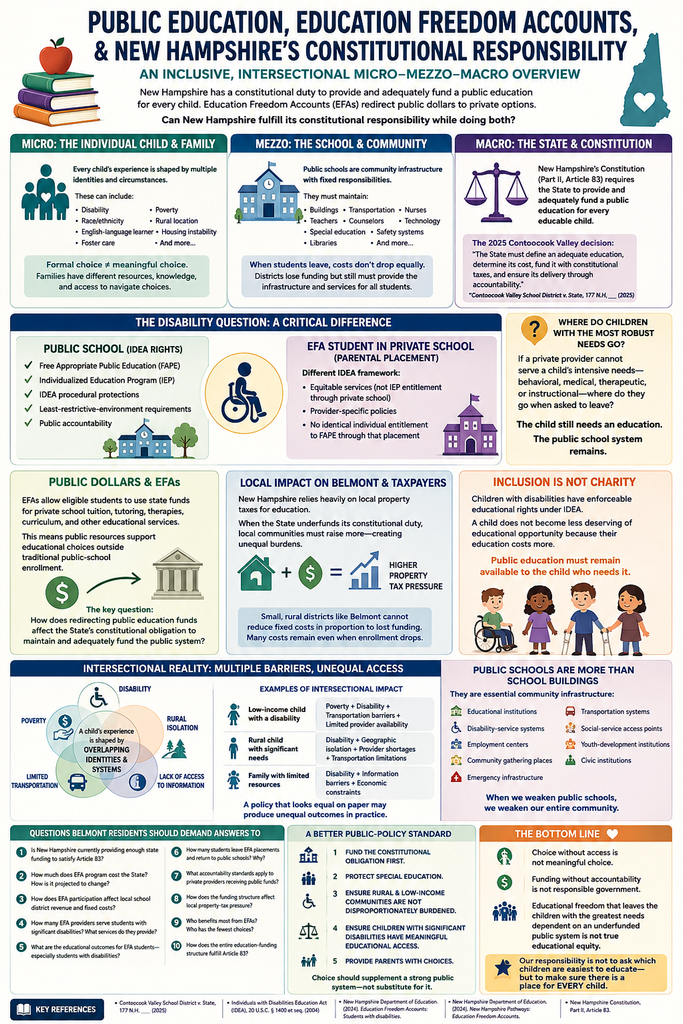
New Hampshire’s Constitution imposes a duty on the State concerning public education. New Hampshire Supreme Court precedent has repeatedly recognized that Part II, Article 83 creates a duty for the State to provide a constitutionally adequate education to every educable child in New Hampshire’s public schools and to guarantee adequate funding (Contoocook Valley School District v. State, 2025). The Court’s 2025 decision is particularly significant because it affirmed that the State’s statutory base adequacy aid was constitutionally insufficient and that the Legislature must address the deficiency.
At the same time, New Hampshire has created Education Freedom Accounts (EFAs), which allow eligible students to direct state-funded education grants toward qualifying educational expenses, including private-school tuition, tutoring, and other educational services (New Hampshire Department of Education [SHED], 2024).
The question I believe we should be asking is therefore not simply whether families should have educational choice.
“The question is whether New Hampshire can fulfill its constitutional responsibility to adequately fund and sustain public education while simultaneously directing public education resources into a system in which private educational providers do not necessarily have the same legal obligations to serve every child.“
That question becomes particularly urgent when viewed through an intersectional lens.
I. Understanding the Issue Through an Intersectional Framework
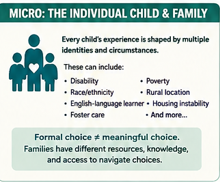
Intersectionality recognizes that people experience institutions differently depending on how multiple social and structural circumstances interact (Crenshaw, 1989). In education, this means that the impact of a policy cannot be understood simply by looking at “students” as one homogeneous population.
A child may simultaneously be:
- Disabled;
- Living in poverty;
- A member of a racial or ethnic minority;
- An English-language learner;
- Living in a rural community;
- Experiencing housing instability;
- A child in foster care;
- A child of a single parent;
- A student requiring specialized transportation;
- Or a child whose family lacks the resources to navigate complicated educational systems.
These identities and circumstances can overlap.
Therefore, an education policy that appears neutral at the macro level can produce very different consequences at the micro level.
This is why I believe the EFA conversation needs to move beyond:
“Does this give parents more choice?”
and toward:
“Who actually has meaningful choices, who has fewer choices, and who remains responsible for the children whom the alternative system cannot or will not serve?”
II. Micro Level: The Individual Child and Family
The child is not an abstraction
At the micro level, education policy affects individual children and families.
A family may seek an EFA because their child:
- Is being bullied;
- Needs a different learning environment;
- Has a particular educational philosophy;
- Needs specialized instruction;
- Wants religious education;
- Needs tutoring;
- Is struggling academically;
- Or simply does not thrive in the assigned public-school environment.
Those reasons should not be dismissed.
I do not believe that supporting public education requires me to disregard families who feel that the public system has failed their child.
Parents deserve to be heard.
But the individual-choice conversation becomes more complicated when the child has significant disabilities or other intensive educational needs.
III. The Disability Question
This is where I believe the EFA debate becomes particularly important.
Public schools operate under the Individuals with Disabilities Education Act (IDEA), which establishes a federal right to a free appropriate public education (FAPE) for eligible children with disabilities (Individuals with Disabilities Education Act [IDEA], 2004).
New Hampshire’s special-education law likewise establishes the State’s responsibility concerning the education of children with disabilities.
This means that a public school cannot simply decide that a particular child is:
“Too expensive.”
or
“Too complicated.”
or
“Not a good fit.”
The public system has legal obligations to address the child’s educational needs.
But a private-school placement operates under a different legal framework.
New Hampshire’s Department of Education explicitly explains that when a child with a disability participates in an EFA and attends a nonpublic school through parent placement, the child is not entitled to special-education services through an IEP in connection with that private-school enrollment (SHED, 2024).
That is an enormous distinction.
Public school:
FAPE
- Individualized Education Program (IEP)
- IDEA procedural protections
- Least-restrictive-environment requirements
- Public accountability
Parentally placed private-school student:
Different IDEA framework
- Equitable-services framework
- Provider-specific policies
- No identical individual entitlement to FAPE through the private-school placement
(SHED, 2024; U.S. Department of Education, 2022).
This does not mean that children with disabilities receive no protections or services in private schools. That would be inaccurate.
It means that the legal entitlement is different.
And that difference matters.
IV. Where Do Children With the Most Significant Needs Go?
This is the question I believe policymakers have not adequately answered for families like mine who are concerned about the long-term health of public education.
What happens to a child who requires:
- Significant behavioral supports;
- Specialized instruction;
- Speech-language services;
- Occupational therapy;
- Physical therapy;
- Specialized transportation;
- Nursing services;
- Assistive technology;
- One-to-one support;
- Intensive academic intervention;
- Or a highly specialized educational environment?
What happens when the private educational provider cannot provide those services?
What happens when the provider does not have the staffing?
What happens when the placement becomes financially or practically impossible?
What happens when the child is asked to leave?
The child still needs an education.
The child’s disability does not disappear.
The child’s right to an education does not disappear.
And the public school system remains.
New Hampshire’s Department of Education recognizes that students with disabilities who participate in EFAs and attend nonpublic schools are generally treated as parentally placed students rather than students entitled to an IEP through that private-school placement (SHED, 2024).
That creates an important structural distinction:
The public school system remains the institution with the broadest responsibility for educating the entire community, even when some public education resources are directed into alternative educational arrangements.
V. Micro-Level Intersectionality: Disability + Poverty + Geography
The disability issue cannot be separated from economic circumstances.
Consider two families.
Family A
Has:
- Financial resources;
- Reliable transportation;
- Flexible employment;
- Knowledge of special education;
- Ability to hire advocates;
- Access to private providers;
- Ability to travel outside the community.
Family B
Has:
- A child with significant disabilities;
- One parent working multiple jobs;
- No reliable transportation;
- Limited access to specialists;
- Housing instability;
- Limited ability to navigate complicated educational systems.
Both families technically have “choice.”
But their actual choices are not equal.
That is intersectionality.
A policy can offer formal choice while producing unequal practical access to that choice.
VI. Mezzo Level: The School and Community
The mezzo level looks at institutions and relationships between individuals and larger systems.
For this issue, the mezzo level includes:
- Belmont School District;
- Teachers;
- Special-education departments;
- School boards;
- Parents;
- Parent-teacher organizations;
- Local taxpayers;
- Transportation systems;
- Community organizations;
- Regional service providers;
- Local government.
This is where the financial implications become tangible.
VII. Public Schools Have Fixed Responsibilities
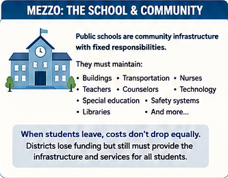
A public school district cannot simply reduce every expense in exact proportion to the number of students who leave.
A school still needs:
- Buildings;
- Heat;
- Electricity;
- Maintenance;
- Transportation;
- Administrative infrastructure;
- Nurses;
- Counselors;
- Special educators;
- Technology;
- Safety systems;
- Libraries;
- Curriculum;
- Compliance systems;
- Emergency preparedness.
Some costs vary with enrollment.
Others do not.
That means that when students leave, the district does not necessarily experience a proportional reduction in expenditures.
This is particularly important in rural communities.
Belmont cannot simply operate like a large urban school district where thousands of students create economies of scale.
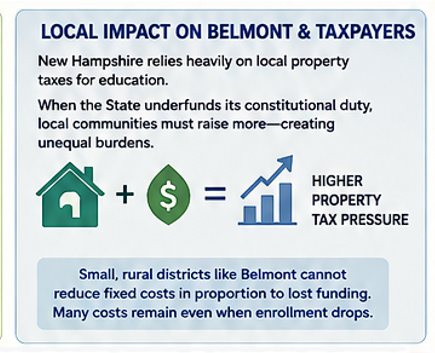
When a small district loses students, many fixed costs remain.
Therefore, the relevant question is not simply:
“How much money follows the student?”
It is:
“How does the loss or redirection of funding interact with the fixed cost of maintaining the public infrastructure that remains legally responsible for the entire community?”
VIII. Mezzo-Level Impact on Teachers and Special Education
Public-school funding is also workforce funding.
When resources become constrained, schools may experience pressure involving:
- Teacher recruitment;
- Teacher retention;
- Special-education staffing;
- Paraprofessional staffing;
- Counseling;
- Nursing;
- Transportation;
- Professional development;
- Classroom size;
- Intervention programs.
The 2025 Contoocook Valley decision is important because the New Hampshire Supreme Court accepted evidence that teachers, non-teacher staff, instructional materials, technology, transportation, facilities, and other components are necessary to provide the opportunity for an adequate education. (Contoocook Valley School District v. State, 2025).
This matters because education funding is not an abstract line on a spreadsheet.
It becomes:
“Do we have the special educator?”
“Can we retain the paraprofessional?”
“Can we keep the school nurse?”
“Can we maintain the building?”
“Can we provide transportation?”
“Can we offer the intervention?”
Those are the real consequences.
IX. Macro Level: The Constitution of New Hampshire
At the macro level, we have to look at the State’s constitutional responsibility.
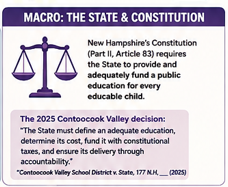
Part II, Article 83 of the New Hampshire Constitution establishes the State’s duty concerning public schools.
New Hampshire Supreme Court precedent has interpreted Article 83 as creating a duty to provide a constitutionally adequate education to every educable child in the public schools and to guarantee adequate funding (Contoocook Valley School District v. State, 2025).
This is critically important:
Public education is not merely a discretionary government program.
New Hampshire’s highest court has recognized education as a fundamental right and has held that the State has an affirmative responsibility to fund an adequate education. (Contoocook Valley School District v. State, 2025).
X. The 2025 Contoocook Valley Decision
This case dramatically changes the context in which we should discuss EFAs.
The New Hampshire Supreme Court held in 2025 that the evidence demonstrated a significant shortfall in the State’s funding of base adequacy aid, creating a clear and substantial conflict between the statutory funding level and Part II, Article 83 of the New Hampshire Constitution. (Contoocook Valley School District v. State, 2025).
The Court reaffirmed that:
The State must define an adequate education, determine its cost, fund it with constitutional taxes, and ensure its delivery through accountability.
(Contoocook Valley School District v. State, 2025).
That means the constitutional conversation is not theoretical.
The State has already been found constitutionally deficient in the funding of public education.
XI. This Does Not Automatically Mean EFAs Have Been Declared Unconstitutional
This distinction is essential.
I would not tell Belmont residents:
“The New Hampshire Supreme Court has ruled that Education Freedom Accounts are unconstitutional.”
That is not an accurate statement.
The constitutional challenge to the EFA program itself has been litigated, and a prior state-court challenge was dismissed. The existence of EFAs has therefore not been judicially declared unconstitutional as a matter of settled law.
The stronger and more defensible argument is:
New Hampshire has an affirmative constitutional obligation to fund adequate public education, and the State has simultaneously established a program directing public education resources toward nonpublic educational arrangements. Given the Supreme Court’s finding that the State’s public-school adequacy funding was constitutionally insufficient, the Legislature has a constitutional responsibility to demonstrate that its overall education-funding structure actually fulfills Article 83.
That is a constitutional argument worth having.
It is also an argument grounded in current case law rather than political rhetoric.
XII. The Public-Funding Question
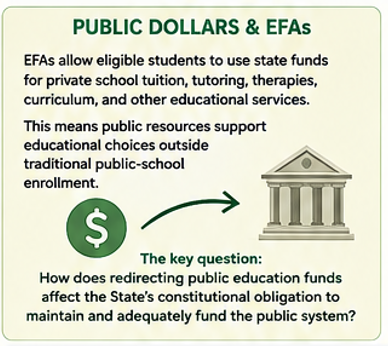
The EFA program allows eligible students to use state-funded education grants for qualifying educational expenses, including private-school tuition and other educational services (SHED, 2024).
That means public resources are supporting educational choices outside traditional public-school enrollment.
Again, I do not think the most useful question is:
“Did Belmont literally write a check to a private school?”
That framing is vulnerable because EFA funds are administered through the state’s funding structure.
The better question is:
“How does the State’s decision to make education funding portable affect its constitutional obligation to maintain and adequately fund the public education system?”
And then:
“Who bears the remaining costs when public-school infrastructure and legal obligations continue even when some students and funding move elsewhere?”
That is the fiscal question Belmont taxpayers deserve answered.
XIII. The Property-Tax Connection
New Hampshire’s education system has historically relied heavily on local property-tax revenue.
This creates a fundamental fairness issue.
If the State underfunds its constitutional responsibility, municipalities must raise additional local revenue to maintain the education system.
That creates unequal burdens because communities have different:
- Property values;
- Tax bases;
- Poverty rates;
- Student populations;
- Special-education populations;
- Infrastructure costs;
- Ability to raise revenue.
This is precisely why the constitutional concept of statewide adequacy matters.
The New Hampshire Supreme Court has emphasized that the Constitution mandates statewide adequacy rather than statewide equality. (Contoocook Valley School District v. State, 2025).
For me, this means Belmont should not have to choose between:
Protecting taxpayers
and
Providing an adequate education.
The State has a constitutional role in ensuring that we can do both.
XIV. Educational Choice vs. Educational Responsibility
I believe we need to distinguish between two concepts:
Educational choice
Parents should have meaningful options.
Educational responsibility
The State must ensure that children actually have access to an adequate education.
These concepts are not inherently incompatible.
But they become incompatible when:
Choice is expanded without ensuring that the public system remains adequately funded and capable of serving the students who depend upon it.
XV. The Disability Community Makes This Question Unavoidable
The public education system has an obligation that the private market does not necessarily have in the same way:
It must remain available to the child who needs it.
A private provider may offer an excellent educational environment for one student.
That does not mean it can necessarily serve:
- A child with profound behavioral needs;
- A child requiring intensive nursing;
- A child requiring specialized transportation;
- A child requiring multiple therapies;
- A child requiring highly specialized instructional equipment;
- A child requiring a level of staffing the provider cannot sustain.
The question therefore becomes:
Who is the safety net?
The answer cannot be:
“The public school will figure it out.”
while simultaneously failing to adequately fund the public school.
XVI. A Public School Is More Than a School Building
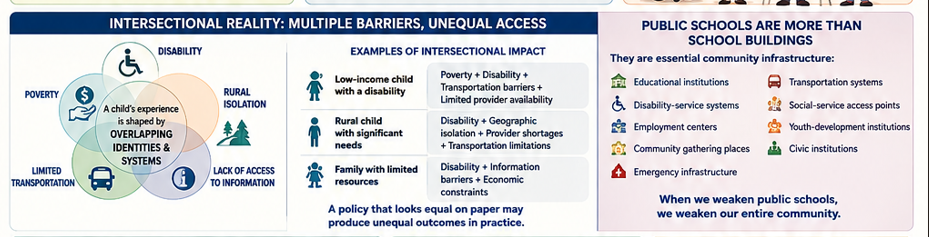
Public schools are community infrastructure.
They are:
- Educational institutions;
- Disability-service systems;
- Employment centers;
- Community gathering places;
- Emergency infrastructure;
- Transportation systems;
- Social-service access points;
- Youth-development institutions;
- Civic institutions.
When we weaken public schools, we are not merely changing where children learn.
We are weakening a major piece of community infrastructure.
That affects everyone.
XVII. Inclusion Is Not Charity
This is especially important when discussing disability.
A child with a disability does not need to “earn” access to public education.
A child does not become less deserving of educational opportunity because their education costs more.
IDEA was built around the principle that children with disabilities have enforceable educational rights (IDEA, 2004).
Therefore, special education should not be treated as an optional add-on that we fund only when convenient.
It is part of what an inclusive public education system is required to provide.
XVIII. Intersectionality at the Macro Level
At the macro level, education policy intersects with:
- Disability policy;
- Tax policy;
- Housing policy;
- Poverty;
- Rural development;
- Civil rights;
- Workforce policy;
- Transportation;
- Healthcare;
- Family policy;
- Religious liberty;
- Constitutional law.
That means education funding is not isolated from the rest of government.
For example:
A low-income disabled child
may experience:
poverty + disability + transportation barriers + limited provider availability
simultaneously.
A rural disabled child
may experience:
disability + geographic isolation + provider shortages + transportation limitations
simultaneously.
A child whose family cannot navigate private educational markets
may experience:
disability + information barriers + economic constraints
simultaneously.
A policy that looks equal on paper may therefore produce unequal outcomes in practice.
XIX. The Religious-School Constitutional Question
There is another constitutional issue that should not be ignored.
New Hampshire’s Constitution contains language in Article 83 concerning public taxation and religious schools.
The provision states that no money raised by taxation shall be granted or applied for the use of schools of institutions of a religious sect or denomination.
EFAs can be used for private-school tuition, including at religious schools.
That creates an additional constitutional question that deserves serious public discussion.
However, again, precision matters.
I would not claim:
“EFAs have been declared unconstitutional because they fund religious schools.”
They have not.
The appropriate statement is:
“The use of public education funds for religious-school tuition raises a serious constitutional question under New Hampshire’s Article 83 that deserves continued legal and public scrutiny.”
That is both stronger and more intellectually honest.
XX. What I Believe Belmont Residents Should Demand
Rather than reducing this issue to partisan slogans, I believe Belmont residents should demand measurable answers.
1. Constitutional adequacy
Is New Hampshire currently providing enough state funding to satisfy Article 83?
The Supreme Court’s 2025 decision indicates that the statutory base adequacy funding was constitutionally insufficient. (Contoocook Valley School District v. State, 2025).
2. Full fiscal transparency
How much does the EFA program cost the State annually?
How has that cost changed?
How is it projected to change?
3. Local fiscal impact
How does EFA participation affect the revenue and fixed costs of local public-school districts?
4. Disability access
How many EFA providers:
- Accept students with significant disabilities?
- Provide specialized services?
- Provide transportation?
- Provide nursing?
- Provide behavioral supports?
- Provide related services?
5. Student outcomes
What are the educational outcomes for EFA students?
What are the outcomes specifically for students with disabilities?
6. Return-to-public-school data
How many students leave EFA placements and return to public schools?
Why?
What services do they require when they return?
7. Provider accountability
What standards apply to private providers receiving public education dollars?
How are complaints investigated?
How are educational outcomes evaluated?
8. Taxpayer impact
How does the overall funding structure affect local property-tax pressure?
9. Equity
Who benefits most from EFAs?
Who has access to the greatest number of choices?
Who has the fewest?
10. Constitutional compliance
Most importantly:
How does the entire education-funding structure fulfill the State’s constitutional responsibility under Article 83?
XXI. A Better Public-Policy Standard
I believe New Hampshire should adopt a simple principle:
Fund the constitutional obligation first.
Before expanding educational-choice programs, the State should demonstrate that it is adequately funding the public education system that it is constitutionally obligated to maintain.
That means:
First:
Fund constitutionally adequate public education.
Second:
Protect special education.
Third:
Ensure rural and low-income communities are not disproportionately burdened.
Fourth:
Ensure children with significant disabilities have meaningful educational access.
Fifth:
Provide parents with choices.
Choice should supplement a strong public system—not substitute for the State fulfilling its constitutional obligation to that system.
XXII. What This Means for Belmont
For Belmont, this is not some abstract issue happening in Concord.
It comes home through:
- Property taxes;
- School budgets;
- Teacher retention;
- Special education;
- Transportation;
- Building maintenance;
- Class sizes;
- Student services;
- Educational opportunities;
- Community stability.
Belmont taxpayers should not be forced into an impossible choice between:
“Raise property taxes or allow public education to deteriorate.”
That is not a sustainable system.
The State has a constitutional obligation to contribute adequately to the educational opportunity of children throughout New Hampshire. (Contoocook Valley School District v. State, 2025).
XXIII. My Position as a Belmont Constituent
I am not asking Belmont residents to oppose parents.
I am asking us to protect the institution that belongs to all of us.
I believe a parent who seeks an EFA deserves to be treated with respect.
I believe a parent whose child thrives in a private school deserves to be heard.
I believe a parent whose child is being failed by their public school deserves help.
But I also believe the child with profound disabilities deserves the same level of public concern.
The child whose private placement fails deserves somewhere to go.
The child who cannot access a private provider deserves somewhere to go.
The child whose family cannot afford transportation deserves somewhere to go.
The child whose educational needs are too intensive for a private provider deserves somewhere to go.
And that somewhere cannot simply be a public school that we have simultaneously allowed to become financially unstable.
XXIV. The Micro–Mezzo–Macro Bottom Line
MICRO — The Child
Does this individual child have meaningful access to an appropriate education?
Especially:
- Disabled children;
- Low-income children;
- Rural children;
- English-language learners;
- Children with intensive needs.
MEZZO — The School and Community
Does Belmont have the resources to maintain a functioning, inclusive public-school system?
That includes:
- Teachers;
- Special educators;
- Paraprofessionals;
- Transportation;
- Buildings;
- Nurses;
- Counselors;
- Technology;
- Student services.
MACRO — The State
Is New Hampshire fulfilling its constitutional responsibility to adequately fund public education?
The New Hampshire Supreme Court’s 2025 Contoocook Valley decision makes clear that this is not merely a political question. It is a constitutional obligation.
XXV. The Question I Want New Hampshire to Answer
Ultimately, I keep coming back to one question:
“If New Hampshire is constitutionally obligated to provide and adequately fund public education, why are we directing increasing amounts of public education resources into alternative educational arrangements while the public system remains responsible for educating every child—including children whose disabilities and needs may make private placement unavailable?“
And I have an even more basic question:
“Where do the children with the most robust needs go?“
Not theoretically.
Not politically.
“Where do they actually go?“
Who provides their education?
Who provides their therapies?
Who provides their transportation?
Who provides their behavioral supports?
Who pays?
And who is legally responsible when the private option cannot serve them?
Those are questions that every policymaker supporting educational freedom should be willing to answer.
Conclusion
I believe educational policy should be judged not by how attractive it sounds in a campaign speech, but by how it functions for the people with the fewest choices.
A genuinely inclusive education system must consider the child who is thriving, the child who is struggling, the child whose family wants an alternative, and the child whose disability requires an extraordinary level of public support.
That requires us to look at education through all three levels.
At the micro level, we must ask whether individual children and families have meaningful educational opportunities.
At the mezzo level, we must protect the schools, teachers, families, and communities responsible for delivering those opportunities.
At the macro level, we must hold the State accountable to its constitutional obligation to provide and adequately fund public education.
For me, this is not about being anti-parent, anti-choice, or anti-private education.
It is about refusing to pretend that all children have the same choices, all providers have the same obligations, or all communities have the same resources.
Choice without access is not meaningful choice.
Funding without accountability is not responsible government.
And educational freedom that leaves the children with the greatest needs dependent on an increasingly underfunded public system is not true educational equity.
New Hampshire’s Constitution requires more of us.
It requires us to build and sustain a public education system capable of serving the children who live here.
And as a Belmont constituent, I believe our responsibility is not to ask which children are easiest to educate.
Our responsibility is to make sure there is a place for every child.
References
Crenshaw, K. (1989). Demarginalizing the intersection of race and sex: A Black feminist critique of antidiscrimination doctrine, feminist theory and antiracist politics. University of Chicago Legal Forum, 1989(1), 139–167.
Individuals with Disabilities Education Act, 20 U.S.C. §§ 1400–1482 (2004).
Contoocook Valley School District v. State, 177 N.H. ___ (2025). https://law.justia.com/cases/new-hampshire/supreme-court/2025/2024-0121.html
New Hampshire Department of Education. (2024). Education Freedom Accounts: Students with disabilities. https://www.education.nh.gov/sites/g/files/ehbemt326/files/inline-documents/sonh/efa-for-students-with-disabilities_0.pdf
New Hampshire Department of Education. (2024). New Hampshire Pathways: Education Freedom Accounts. https://www.education.nh.gov/sites/g/files/ehbemt326/files/inline-documents/sonh/nhdoe-resource-guide.pdf
New Hampshire General Court. (n.d.). New Hampshire Constitution, Part II, Article 83. https://gc.nh.gov/legislation/2000/CACR0026.html
U.S. Department of Education, Office of Special Education Programs. (2022). Questions and answers on serving children with disabilities placed by their parents in private schools. https://sites.ed.gov/idea/idea-files/questions-and-answers-on-serving-children-with-disabilities-placed-by-their-parents-in-private-schools/