
Over the last several weeks, many people who loved Luca or who simply felt shaken by the violence of what happened have been trying to piece together information from fragmented media reporting, court filings, affidavits, and public records requests. As someone who knew Luca for many years, I have been following the case carefully while staying grounded in facts rather than speculation.
This post is an effort to explain the newest developments in the criminal case involving the homicide of Lucas Ameh Avery Knapp, what those developments actually mean legally, and just as importantly, what they do not mean.
Most importantly, I want to keep Luca at the center of this conversation.
Because Luca was not simply a “case,” a headline, or a docket number.
He was a deeply loved human being.
He was a queer and trans community member, a farmer, artist, musician, traveler, dreamer, caretaker, and friend. He was someone who believed in people fiercely. Someone who built community in rural spaces where many of us understood both the beauty and vulnerability that can exist there simultaneously.
And on April 18, 2026, Luca was killed in the Candy Kitchen / Ramah region of Cibola County, New Mexico.
What the New Court Updates Show
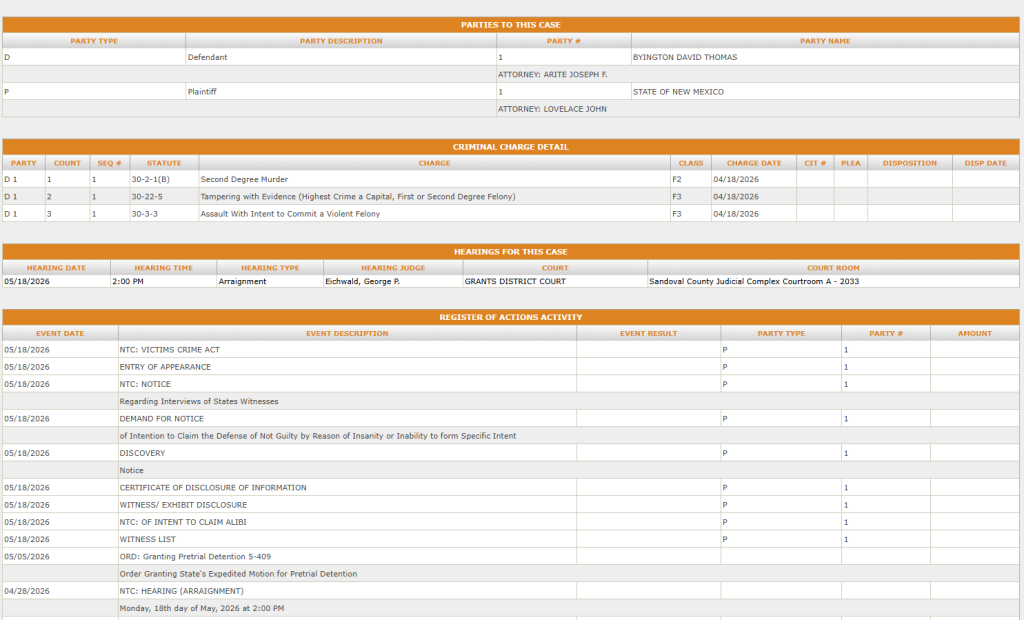
Recent filings in the New Mexico district court system show several major procedural developments in the prosecution against David Thomas Byington.
1. A Grand Jury Indictment Was Issued
One of the most significant updates is that a grand jury indictment was formally entered on April 24, 2026.
Legally, a grand jury indictment means that prosecutors presented evidence to a grand jury, and that grand jury determined there was probable cause to proceed with felony charges in district court. It does not determine guilt, nor is it a conviction. Rather, it signifies that prosecutors presented sufficient evidence for the case to move into formal prosecution (New Mexico Courts, 2026).
The currently listed charges against David Thomas Byington include:
- Second Degree Murder
- Tampering with Evidence
- Assault With Intent to Commit a Violent Felony
This matters because the case is no longer simply in an initial arrest or emergency-response phase. It has formally entered a structured felony prosecution process.
2. Pretrial Detention Was Granted
On May 5, 2026, the court granted the State’s motion for pretrial detention.
This is a significant legal finding under New Mexico law. In order to hold someone without release pending trial, prosecutors must convince the court by “clear and convincing evidence” that no release conditions would reasonably protect the safety of the community (State v. Anderson, 2023; NMRA Rule 5-409).
The prosecution argued that:
- a firearm was used,
- the shooting escalated from an argument,
- evidence may have been concealed,
- and that the defendant posed an ongoing danger if released.
The judge ultimately agreed to detention pending further proceedings.
Again, this does not determine guilt. But it does indicate the court found the State’s dangerousness arguments persuasive enough to justify detention before trial.
3. The Case Has Entered Discovery and Trial Preparation
Several filings dated May 18, 2026, include:
- witness disclosures,
- exhibit disclosures,
- discovery notices,
- and procedural notices regarding witness interviews.
In practical terms, this means prosecutors and defense attorneys are now formally exchanging evidence and preparing for litigation.
This phase typically includes:
- witness statements,
- forensic evidence,
- investigative reports,
- photographs,
- recordings,
- and other materials relevant to trial preparation.
An arraignment was also scheduled before Judge George P. Eichwald in district court.
What These Updates Do Not Mean
Because information spreads rapidly online, especially in emotionally charged cases, it is important to distinguish between confirmed procedural facts and assumptions.
These updates do not mean:
- that anyone has been convicted;
- that every allegation publicly discussed has been proven;
- that all questions surrounding the case have been answered;
- or that all investigative avenues have necessarily concluded.
There are still significant unanswered public questions.
Ongoing Public Questions and Inconsistencies
Several issues remain publicly unclear based on currently available records and reporting.
The October 11, 2025, Reference
Affidavit materials repeatedly reference October 11, 2025, despite the homicide occurring on April 18, 2026. The public significance of that earlier date has not yet been clearly explained within available records.
Changes in Charges
Earlier public reporting referenced additional allegations involving:
- shooting from a vehicle,
- and felon-in-possession firearm allegations.
Some of those allegations do not currently appear in the active indictment. That does not necessarily mean those underlying factual claims disappeared. Charges can evolve as prosecutors refine their litigation strategy or present evidence differently before a grand jury.
Additional Individual Reportedly Shot At
Public reporting and affidavits have also referenced another person who may have been shot at or endangered during the incident. Publicly available records still provide limited clarity regarding that individual’s identity or status.
Bias-Motivated Violence Concerns
Many people within the LGBTQIA+ community have understandably questioned whether anti-trans or anti-queer bias may have contributed to the events leading to Luca’s death.
At this time, publicly filed charging documents do not designate the homicide as a hate crime.
That absence does not, in itself, prove or disprove biased motivation. It simply means that, as of current public filings, no hate crime enhancement or formal bias designation has been publicly filed.
It is also important to recognize that proving bias-motivated intent under criminal law often requires more specific evidentiary standards than mere community suspicion or concern.
Why Transparency Matters
Many community members, journalists, and advocates have submitted requests under New Mexico’s Inspection of Public Records Act (IPRA) seeking:
- CAD logs,
- dispatch information,
- body camera records,
- affidavits,
- hearing records,
- and supplemental reports.
Part of the reason for this is simple:
People are trying to understand what happened to Luca fully and accurately.
Transparency matters not because people are seeking spectacle, but because public trust in investigative integrity matters deeply, especially in cases involving marginalized communities, firearms, rural isolation, and conflicting narratives.
Keeping Luca at the Center
It is easy for legal language to flatten a human life into procedural terminology:
“victim.”
“decedent.”
“complainant.”
“case number.”
But Luca was not paperwork.
He was someone who made people feel seen.
Someone who offered shelter, conversation, food, music, laughter, and care to people who often lived at the edges of conventional society. Many of us knew Luca through queer land projects, rural community spaces, farming networks, mutual aid circles, music gatherings, and shared visions for alternative ways of living.
Whatever ultimately unfolds legally, that truth remains unchanged.
Moving Forward Carefully and Factually
As this case progresses, I believe it is important that we:
- remain factual,
- avoid misinformation,
- allow space for due process,
- continue advocating for transparency,
- and keep Luca’s humanity at the center of every conversation.
This case is still evolving.
There are still unanswered questions.
And there are still many people grieving someone they loved deeply.
-George ( lefthandfeed )
References
New Mexico Courts. (2026). Case Lookup System. https://caselookup.nmcourts.gov/caselookup/app
State v. Anderson, 2023-NMSC-019 (N.M. 2023).
New Mexico Rules Annotated Rule 5-409. Pretrial detention proceedings.